Skip to content

How to Contribute to Blitz.JS

This article was written over 18 months ago and may contain information that is out of date. Some content may be relevant but please refer to the relevant official documentation or available resources for the latest information.

This Dot Media is kicking off a brand new series of videos in 2022 to help developers learn how they can contribute code to some of the world’s most popular JavaScript frameworks and technologies. Subscribe to This Dot Media’s Youtube Channel.

In the newest episode of this series, looking at the best practices for contributing to open-source web frameworks, I spoke with Brandon Bayer, Founder of Flightcontrol and Creator of Blitz.js. If you would like to check out that interview, you can see it here.

What is Blitz.js?

Blitz.js is a web framework built on Next.js that offers out-of-the-box features including a “Zero-API” data layer that eliminates the need for REST/GraphQL, and was modeled after Ruby on Rails.

Brandon Bayer

Brandon Bayer is the Founder of Flightcontrol, a full-stack deploy platform for Nest.js and Blitz.js. Additionally, he is the Creator of Blitz.js, and also offers independent software engineering consulting services. Brandon created Blitz.js after coming from the Ruby on Rails community, and wanting something similar with “batteries included” in the JavaScript ecosystem.

What to Know Before You Get Started

Developers who are interested in contributing to Blitz.js should visit the Blitz.js repository, read the documentation to learn how to contribute, and discover more about the community!

Quick Tips!

  • Check out Blitz Project Dashboard on Github, and view the “ready to work on” column for issues that have been unassigned and need help!
  • Join the Discord and get involved in the community!

The Best Way to Get Started

Those who are just getting started with contributing to Blitz.js can help with code reviews, documentation, and addressing issues in the “ready to work on” column in the Blitz.js repository. If you are interested in working on a particular issue, you can comment on it, it will be assigned to you, and then you can start working on it.

Quick Tips!

  • To find ideal issues for new contributors, look for the tags “good first issue” and “second first issue”.
  • If you are using Blitz and you find a bug, you are encouraged to bring that to the attention of maintainers.
  • If you are looking to build relationships and get involved on a regular basis, you can become a maintainer. There are different levels of maintainers like L1, L2, and Core Team. On the Blitzjs.com documentation page, there are descriptions on what it means to be what type of maintainer.

How to Submit a PR

Once you submit a PR, someone should review it within a few days, possibly request that you make changes, and then it may be merged. Sometimes PRs might be on hold until there is a release, but usually they are merged immediately.

Quick Tip!

The Blitz.js team doesn't have a lot of people reviewing PRs, so contributors are welcome to look at PRs and comment to make suggestions!

What About Attending Core Team Meetings?

Currently, the Core Team does not offer contributor meetings. However, earlier in the framework’s history, the Core Team hosted meetings that were recorded and shared on the Blitz.js Youtube channel if you would like to review old meetings.

__Are There Ways to Contribute to the Ecosystem Without Coding?

Those interested in contributing to the Blitz.js ecosystem without contributing code can:

  • Help triage issues when new issues come through - if there is a bug, see if you can reproduce it, or ask the original person for details.
  • Speaking at meetups and conferences.
  • Making courses and writing books.
  • Translating the docs into other written languages.
  • Contribute anything that can spread the word about Blitz.js!

Blitz.js Success Stories

Aleksandra, who is a TypeScript expert, started using and contributing to Blitz.js. Whenever there was a particularly challenging problem with Blitz in TypeScript, Brandon Bayer would go to her and ask for help. That led to her working full time for Blitz.js!

Level 2 maintainers Simon and Juan have been successful too. Simon, who has only recently gotten started with the project, has been super helpful in building items like SuperJSON. Juan got started through translating docs, and he’s been working as a Maintainer ever since.

Ready to Begin?

You can find the Blitz.js Github repository here.

This Dot is a consultancy dedicated to guiding companies through their modernization and digital transformation journeys. Specializing in replatforming, modernizing, and launching new initiatives, we stand out by taking true ownership of your engineering projects.

We love helping teams with projects that have missed their deadlines or helping keep your strategic digital initiatives on course. Check out our case studies and our clients that trust us with their engineering.

You might also like

Next.js + MongoDB Connection Storming cover image

Next.js + MongoDB Connection Storming

Building a Next.js application connected to MongoDB can feel like a match made in heaven. MongoDB stores all of its data as JSON objects, which don’t require transformation into JavaScript objects like relational SQL data does. However, when deploying your application to a serverless production environment such as Vercel, it is crucial to manage your database connections properly. If you encounter errors like these, you may be experiencing Connection Storming: * MongoServerSelectionError: connect ECONNREFUSED <IP_ADDRESS>:<PORT> * MongoNetworkError: failed to connect to server [<hostname>:<port>] on first connect * MongoTimeoutError: Server selection timed out after <x> ms * MongoTopologyClosedError: Topology is closed, please connect * Mongo Atlas: Connections % of configured limit has gone above 80 Connection storming occurs when your application has to mount a connection to Mongo for every serverless function or API endpoint call. Vercel executes your application’s code in a highly concurrent and isolated fashion. So, if you create new database connections on each request, your app might quickly exceed the connection limit of your database. We can leverage Vercel’s fluid compute model to keep our database connection objects warm across function invocations. Traditional serverless architecture was designed for quick, stateless web app transactions. Now, especially with the rise of LLM-oriented applications built with Next.js, interactions with applications are becoming more sequential. We just need to ensure that we assign our MongoDB connection to a global variable. Protip: Use global variables Vercel’s fluid compute model means all memory, including global constants like a MongoDB client, stays initialized between requests as long as the instance remains active. By assigning your MongoDB client to a global constant, you avoid redundant setup work and reduce the overhead of cold starts. This enables a more efficient approach to reusing connections for your application’s MongoDB client. The example below demonstrates how to retrieve an array of users from the users collection in MongoDB and either return them through an API request to /api/users or render them as an HTML list at the /users route. To support this, we initialize a global clientPromise variable that maintains the MongoDB connection across warm serverless executions, avoiding re-initialization on every request. ` Using this database connection in your API route code is easy: ` You can also use this database connection in your server-side rendered React components. ` In serverless environments like Vercel, managing database connections efficiently is key to avoiding connection storming. By reusing global variables and understanding the serverless execution model, you can ensure your Next.js app remains stable and performant....

“Music and code have a lot in common,” freeCodeCamp’s Jessica Wilkins on what the tech community is doing right to onboard new software engineers cover image

“Music and code have a lot in common,” freeCodeCamp’s Jessica Wilkins on what the tech community is doing right to onboard new software engineers

Before she was a software developer at freeCodeCamp, Jessica Wilkins was a classically trained clarinetist performing across the country. Her days were filled with rehearsals, concerts, and teaching, and she hadn’t considered a tech career until the world changed in 2020. > “When the pandemic hit, most of my gigs were canceled,” she says. “I suddenly had time on my hands and an idea for a site I wanted to build.” That site, a tribute to Black musicians in classical and jazz music, turned into much more than a personal project. It opened the door to a whole new career where her creative instincts and curiosity could thrive just as much as they had in music. Now at freeCodeCamp, Jessica maintains and develops the very JavaScript curriculum that has helped her and millions of developers around the world. We spoke with Jessica about her advice for JavaScript learners, why musicians make great developers, and how inclusive communities are helping more women thrive in tech. Jessica’s Top 3 JavaScript Skill Picks for 2025 If you ask Jessica what it takes to succeed as a JavaScript developer in 2025, she won’t point you straight to the newest library or trend. Instead, she lists three skills that sound simple, but take real time to build: > “Learning how to ask questions and research when you get stuck. Learning how to read error messages. And having a strong foundation in the fundamentals” She says those skills don’t come from shortcuts or shiny tools. They come from building. > “Start with small projects and keep building,” she says. “Books like You Don’t Know JS help you understand the theory, but experience comes from writing and shipping code. You learn a lot by doing.” And don’t forget the people around you. > “Meetups and conferences are amazing,” she adds. “You’ll pick up things faster, get feedback, and make friends who are learning alongside you.” Why So Many Musicians End Up in Tech A musical past like Jessica’s isn’t unheard of in the JavaScript industry. In fact, she’s noticed a surprising number of musicians making the leap into software. > “I think it’s because music and code have a lot in common,” she says. “They both require creativity, pattern recognition, problem-solving… and you can really get into flow when you’re deep in either one.” That crossover between artistry and logic feels like home to people who’ve lived in both worlds. What the Tech Community Is Getting Right Jessica has seen both the challenges and the wins when it comes to supporting women in tech. > “There’s still a lot of toxicity in some corners,” she says. “But the communities that are doing it right—like Women Who Code, Women in Tech, and Virtual Coffee—create safe, supportive spaces to grow and share experiences.” She believes those spaces aren’t just helpful, but they’re essential. > “Having a network makes a huge difference, especially early in your career.” What’s Next for Jessica Wilkins? With a catalog of published articles, open-source projects under her belt, and a growing audience of devs following her journey, Jessica is just getting started. She’s still writing. Still mentoring. Still building. And still proving that creativity doesn’t stop at the orchestra pit—it just finds a new stage. Follow Jessica Wilkins on X and Linkedin to keep up with her work in tech, her musical roots, and whatever she’s building next. Sticker illustration by Jacob Ashley....

Intro to DevRel: What's the Difference Between External and Internal DevRel Programs? cover image

Intro to DevRel: What's the Difference Between External and Internal DevRel Programs?

Developer Relations (DevRel) is a proactive, multifaceted discipline that bridges the gap between developers and companies to drive adoption while cultivating an energetic and supportive developer community for their product, service, or technology. The term and the profession are often misunderstood even among those in other technical roles. Some have never heard of DevRel before, and others believe it’s a kind of tech support for developers. Many organizations even think starting a DevRel program means just giving away free software and hoping it catches on. But DevRel is none of these things. At its core, a successful DevRel program builds strong bonds within their target market to ensure that developers can interface with a company or organization behind the product they’re using. Great teams establish authentic connections with developers, cultivate trust, and actively engage with them. DevRel defies traditional marketing strategies. Instead of prioritizing numbers and eyes that contribute to a sales funnel, it focuses on enhancing developer satisfaction. This creates a feedback loop between users and a company to better meet their needs, and foster a sense of collaboration within a product’s user community. The Two Main Domains of Developer Relations DevRel is split into 2 main domains: external and internal. External: Accessing an existing developer community If a company already has a product with an existing community or a product that may appeal to an existing community, and they want to establish a DevRel program around it, this would fall within the external domain. A successful external program will establish credibility and support developers through a number of evangelistic measures like blog posts, tutorials, webinars, giving talks at meetups and conferences, or creating useful code examples to teach concepts. These activities and their goals are rarely product-specific. Instead, they incorporate a number of technologies within their product’s technical ecosystem to demonstrate its value to a developer’s workflow. I had the pleasure of working with Doron Sherman during his tenure at Cloudinary as VP of Developer Relations. Doron has extensive experience with building developer communities, and successfully advocated internally to build a website called Media Jams, a learning resource for developers working with media in their apps. By having this initiative live under Developer Relations, and not under Product, Marketing, or Engineering, Doron and his team built quickly and created a site that prioritized education, without needing to meet the business objectives of other parts of the organization. > “Media Jams has had great organic growth as a community resource. We were able to attract non-Cloudinary users as well as organic search traffic of those looking for media use cases who would have otherwise gotten lost in the Cloudinary docs and/or could not find help through the Cloudinary blog or knowledge base.” says Doron. Internal: Building a developer community In order to support the adoption and retention of developers using a product, companies must have a space where developers can interface with them. Building their own community around a product is the best way to do this. By creating open lines of communication, developers can provide immediate feedback about a product in a productive way to product and engineering teams thereby shortening the feedback loop and improving the speed at which a team is able to innovate based on user needs. This strategy falls under the internal domain. These forums also provide synergistic opportunities for developers that are using a product to learn from each other. By working on similar problems, developers are able to bond and feel more ownership or excitement toward a product, increasing user retention. Danny Thompson, a developer influencer and mentor who has built a community of over a quarter million followers, says that he admires Appwrite’s DevRel program, helmed by Tessa Mero, Head of Developer Relations: > “The Appwrite DevRel team is great at answering questions. They are on Discord, jumping on calls with developers, answering questions, and doing office hours, all of which are super valuable in building that community. The main difference between Appwrite DevRel and other teams is, a lot of communities are run very passively and not always available or taking an active approach within community forums to help out.” - Danny Thompson on Appwrite. > “When we think about how to become successful as a company through DevRel, our first consideration is, what made us successful in the first place? Appwrite became an open-source company and a successful open-source project because of community, so we focus on a community-first approach. Contributors and developers that have supported us since before we were a company are what led us to where we are now. Every initiative, every planning, and everything we do on our team, we consider the community's feedback and perspective before we make any decisions.” - Tessa Mero at Appwrite. The Value-First Approach to Developer Relations Successful DevRel programs prioritize delivering value to cultivate credibility among developers and support product adoption free from reciprocal demands. External efforts involve engaging with existing technology communities, establishing credibility through various evangelistic measures, and delivering value to the community. On the other hand, internal programs build communities around their product, facilitating direct communication between developers and the company. These internal forums not only enhance user retention but also foster a space for developers to learn from each other, creating a sense of ownership and excitement around the product. And by diverting equity to these two programs, DevRel teams find new users, retain them, and receive invaluable feedback. Real-world examples, such as Doron Sherman's work at Cloudinary and Tessa Mero's leadership at Appwrite, showcase the effectiveness of DevRel in action, and highlight how DevRel programs contribute to the success and sustainability of developer-focused products. In the ever-evolving landscape of technology, DevRel emerges not only as a bridge between developers and organizations, but as a crucial driver of innovation, ensuring products remain relevant, adaptive, and deeply integrated into the communities they serve. If you’re thinking about building a successful DevRel program for the first time, the best place to start is to reflect on some of your favorite brands and how they connect with the developer community. Do they simply distribute discount codes and free swag, or are they reaching out to their users, and providing them a platform to learn, collaborate with others, and contribute? If they are, what methods do they use, and how do those methods coincide with your team’s existing strengths? And if you ever have any questions or want to connect with a DevRel specialist, do not hesitate to reach out!...

What does it actually look like to build software with AI today? Not in theory, but in practice. cover image

What does it actually look like to build software with AI today? Not in theory, but in practice.

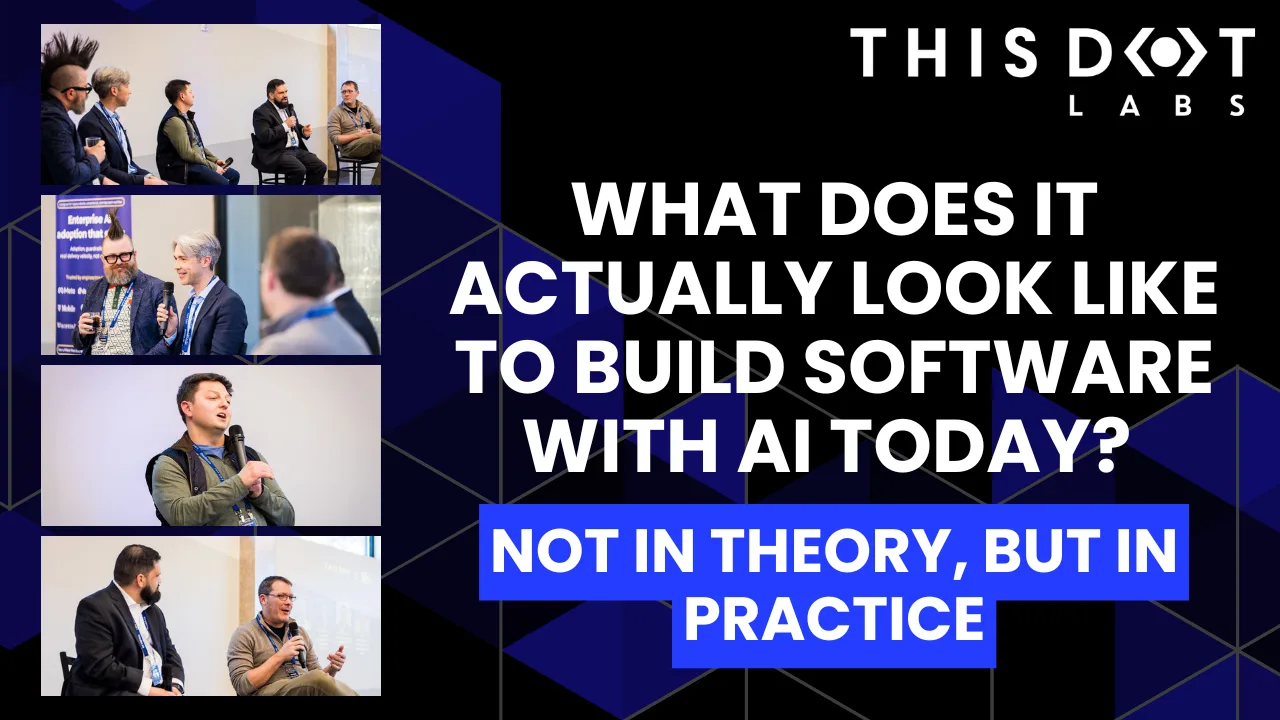
What does it actually look like to build software with AI today? Not in theory, but in practice. At the Leadership Exchange, this was the question at the center of the Developer Panel, where leaders from across the industry unpacked what’s really changing inside engineering teams and what organizations need to do right now to keep up. The Developer Panel at the Leadership Exchange explored the cutting edge of AI in software engineering and examined what organizations should focus on today to prepare for the future. Moderated by Jeff Cross, Co-Founder & CEO at Nx, the panel featured Victor Savkin, Cofounder & CTO at Nx, Alex Sover, Vice President of Engineering at OpenAP, Brent Zucker, Senior Director of Engineering at Visa, and Jonathan Fontanez, AI Engineering Lead at This Dot Labs. Panelists shared insights into how AI is transforming the software development lifecycle and how teams can adopt tools effectively while preparing for organizational change. Panelists discussed emerging workflows, including CI-in-the-loop, agentic healing, and context engineering. They examined how validation, code reviews, and PRDs are evolving alongside AI capabilities and how teams are integrating external sources such as production traces to improve quality and reliability. The discussion also covered what the next generation of agentic tools might look like and how these capabilities will shape engineering practices in the near future. Adoption of AI comes with challenges. Teams often rely on plugins or extensions without foundational understanding, and individual contributors may fear displacement. Panelists emphasized that education, governance, and skill-building are essential for teams to manage AI agents effectively while maintaining quality. They also highlighted the need to standardize workflows and ensure organizational alignment to fully leverage AI capabilities. The conversation extended beyond technical challenges to organizational implications. Panelists discussed how teams can avoid issues like Conway’s Law, manage distributed teams effectively, and evolve engineering practices alongside AI adoption. Leadership and management strategies play a crucial role in ensuring that AI integration delivers meaningful outcomes while maintaining efficiency and alignment with business objectives. Key Takeaways - AI workflows require both technical and organizational preparation. - Education, governance, and skill development are essential for successful implementation. - Forward-looking teams are rethinking validation, CI pipelines, and context management to fully leverage agentic AI. The discussion highlighted that adopting AI at the cutting edge is not just about new tools - it is about rethinking processes, workflows, and organizational culture. Companies that embrace this holistic approach are most likely to succeed in leveraging AI to its full potential. Are you interested in more conversations like this? Message us for an invite to the next, or for a private discussion around these topics. Tracy can be reached at tlee@thisdot.co....

Let's innovate together!

We're ready to be your trusted technical partners in your digital innovation journey.

Whether it's modernization or custom software solutions, our team of experts can guide you through best practices and how to build scalable, performant software that lasts.

Prefer email? hi@thisdot.co