Developer Insights
Join millions of viewers! Our engineers craft human-written articles solving real-world problems weekly. Enjoy fresh technical content and numerous interviews featuring modern web advancements with industry leaders and open-source authors.
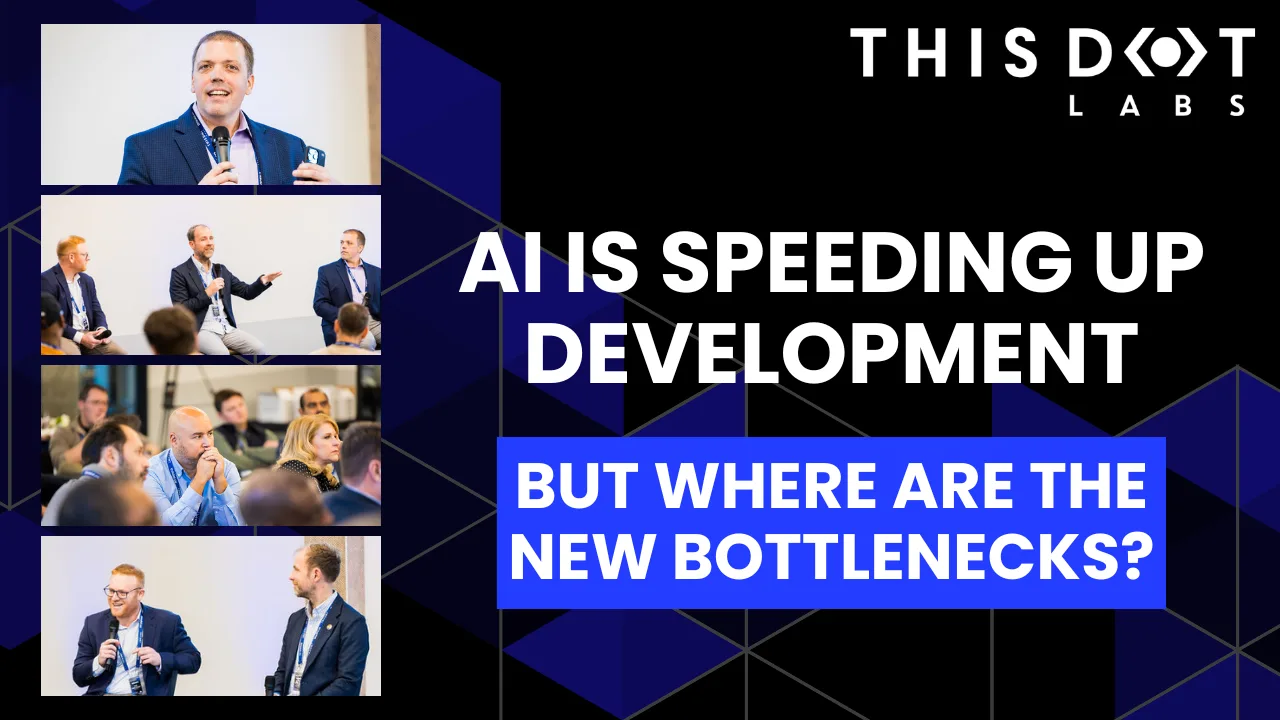
AI Is Speeding Up Development. But Where Are the New Bottlenecks?
AI is accelerating development, but it’s also exposing everything else that’s broken. At the Leadership Exchange, leaders unpacked how AI is reshaping the SDLC and what organizations need to address beyond just coding to make adoption successful. Moderated by Rob Ocel, VP of Innovation at This Dot Labs, the panel featured Itai Gerchikov at Anthropic and Harald Kirschner, Principal Product Manager for GitHub Copilot & VS Code at Microsoft. Panelists explored the current state of AI adoption across the software development lifecycle and shared practical insights into how organizations can effectively integrate AI tools. Panelists discussed how companies are investing in AI tools, skills, and managed competency programs to support developers. While AI can dramatically accelerate coding, the panel emphasized that adoption affects every stage of the SDLC. Bottlenecks now appear in testing, DevOps, product delivery, and marketing as AI speeds up development. Organizations that address technical debt and process inefficiencies are better positioned to extract maximum value from AI tools. The conversation also focused on opportunities and risks. Security, governance, and workforce education were highlighted as critical factors for adoption. Panelists stressed that AI initiatives should be aligned with broader business goals rather than pursued in isolation. They noted that companies experimenting at the cutting edge need to consider organizational readiness just as carefully as technical capabilities. Panelists also explored how leading organizations are navigating the early stages of adoption. Those ahead of the curve are using structured experimentation, prioritizing process improvements, and continuously evaluating outcomes to refine their AI strategies. Learning from these early adopters allows other organizations to anticipate emerging trends and prepare for the next phase of AI adoption rather than simply replicating past approaches. Key Takeaways - Investing in AI skills and tools should be done thoughtfully, with clear alignment to business objectives. - Examining the full SDLC helps identify bottlenecks that AI may accelerate or expose. - Organizations can gain a competitive advantage by learning from early adopters and planning for where AI adoption is heading. AI adoption is not just a technical initiative; it is a strategic transformation that requires attention to people, process, and technology. Organizations that balance innovation with operational discipline will be best positioned to capture the full potential of AI across the software lifecycle. Seeing similar challenges in your own SDLC? Let’s compare notes. Join us at an upcoming Leadership Exchange or reach out to continue the conversation. Tracy can be reached at tlee@thisdot.co....
Mar 27, 2026
2 mins
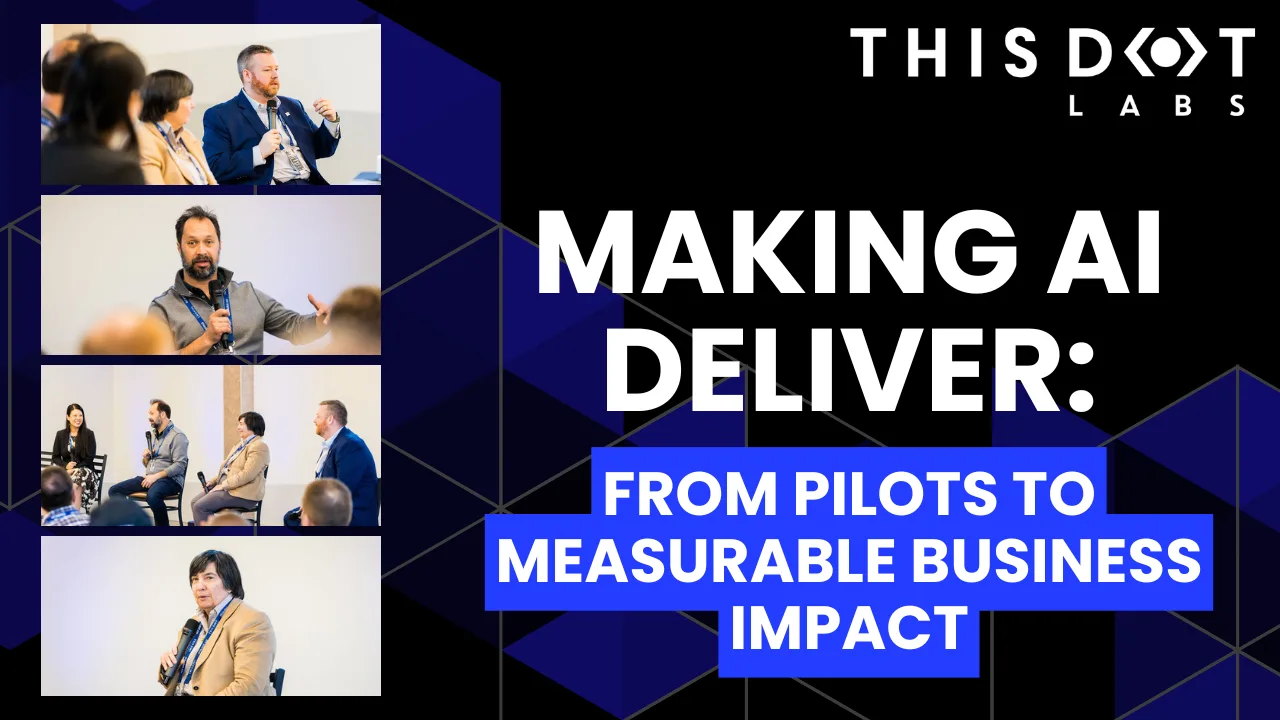
Making AI Deliver: From Pilots to Measurable Business Impact
A lot of organizations have experimented with AI, but far fewer are seeing real business results. At the Leadership Exchange, this panel focused on what it actually takes to move beyond experimentation and turn AI into measurable ROI. Over the past few years, many organizations have experimented with AI, but the challenge today is translating experimentation into measurable business value. Moderated by Tracy Lee, CEO at This Dot Labs, panelists featured Dorren Schmitt, Vice President IT Strategy & Innovation at Allen Media Group, Greg Geodakyan, CTO at Client Command, and Elliott Fouts, CAIO & CTO at This Dot Labs. Panelists discussed how companies are moving from early AI experiments to initiatives that deliver real results. They began by examining how experimentation has evolved over the past year. While many organizations did not fully utilize AI experimentation budgets in 2025, 2026 is showing a shift toward more intentional investment. Structured budgets and clearly defined frameworks are enabling companies to explore AI strategically and identify initiatives with high potential impact. The conversation then turned to alignment and ROI. Panelists highlighted the importance of connecting AI projects to corporate strategy and leadership priorities. Ensuring that AI initiatives translate into operational efficiency, productivity gains, and measurable business impact is essential. Companies that successfully align AI efforts with organizational goals are better equipped to demonstrate tangible outcomes from their investments. Moving from pilots and proofs of concept to production was another major focus. Governance, prioritization, and workflow integration were cited as essential for scaling AI initiatives. One panelist shared that out of nine proofs of concept, eight successfully launched, resulting in improvements in quality and operational efficiency. Panelists also explored the future of AI within organizations, including the potential for agentic workflows and reduced human-in-the-loop processes. New capabilities are emerging that extend beyond coding tasks, reshaping how teams collaborate and how work is structured across departments. Key Takeaways - Structured experimentation and defined budgets allow organizations to explore AI strategically and safely. - Alignment with business priorities is essential for translating AI capabilities into measurable outcomes. - Governance and workflow integration are critical to moving AI initiatives from pilot stages to production deployment. Successfully leveraging AI requires a balance between experimentation, strategic alignment, and operational discipline. Organizations that approach AI as a structured, measurable initiative can capture meaningful results and unlock new opportunities for innovation. Curious how your organization can move from AI experimentation to real impact? Let’s talk. Reach out to continue the conversation or join us at an upcoming Leadership Exchange. Tracy can be reached at tlee@thisdot.co....
Mar 27, 2026
2 mins
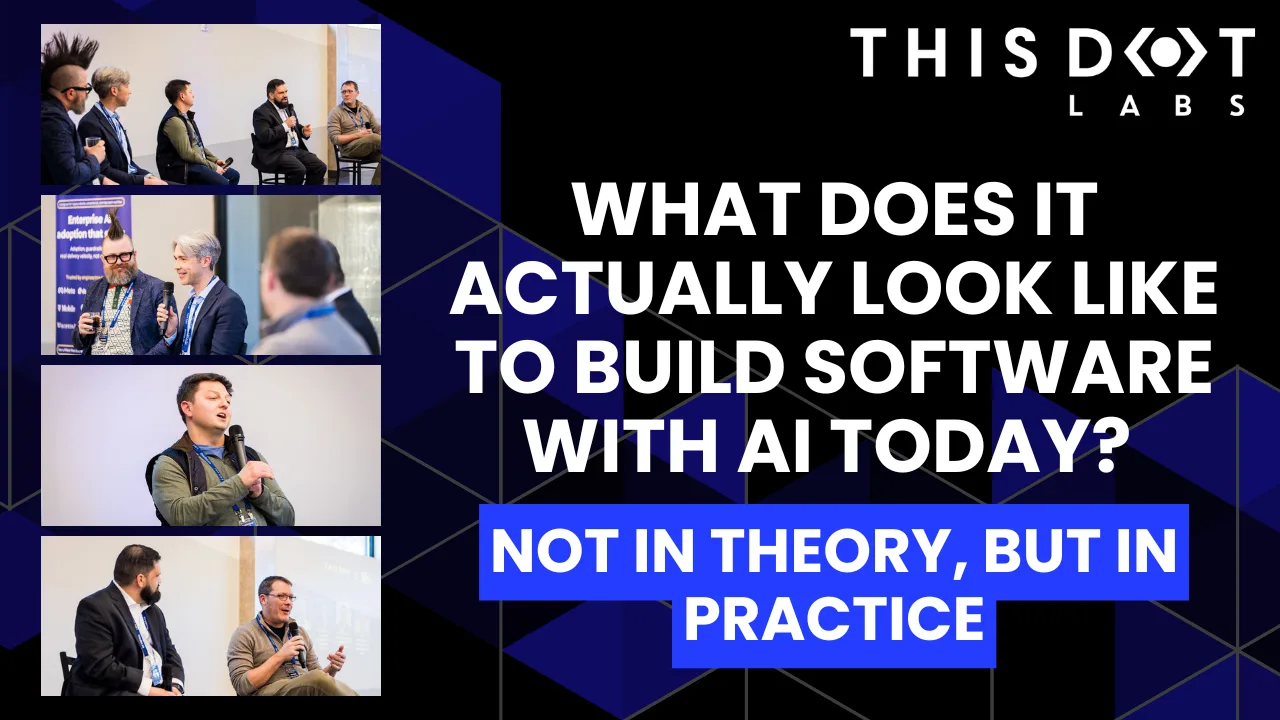
What does it actually look like to build software with AI today? Not in theory, but in practice.
What does it actually look like to build software with AI today? Not in theory, but in practice. At the Leadership Exchange, this was the question at the center of the Developer Panel, where leaders from across the industry unpacked what’s really changing inside engineering teams and what organizations need to do right now to keep up. The Developer Panel at the Leadership Exchange explored the cutting edge of AI in software engineering and examined what organizations should focus on today to prepare for the future. Moderated by Jeff Cross, Co-Founder & CEO at Nx, the panel featured Victor Savkin, Cofounder & CTO at Nx, Alex Sover, Vice President of Engineering at OpenAP, Brent Zucker, Senior Director of Engineering at Visa, and Jonathan Fontanez, AI Engineering Lead at This Dot Labs. Panelists shared insights into how AI is transforming the software development lifecycle and how teams can adopt tools effectively while preparing for organizational change. Panelists discussed emerging workflows, including CI-in-the-loop, agentic healing, and context engineering. They examined how validation, code reviews, and PRDs are evolving alongside AI capabilities and how teams are integrating external sources such as production traces to improve quality and reliability. The discussion also covered what the next generation of agentic tools might look like and how these capabilities will shape engineering practices in the near future. Adoption of AI comes with challenges. Teams often rely on plugins or extensions without foundational understanding, and individual contributors may fear displacement. Panelists emphasized that education, governance, and skill-building are essential for teams to manage AI agents effectively while maintaining quality. They also highlighted the need to standardize workflows and ensure organizational alignment to fully leverage AI capabilities. The conversation extended beyond technical challenges to organizational implications. Panelists discussed how teams can avoid issues like Conway’s Law, manage distributed teams effectively, and evolve engineering practices alongside AI adoption. Leadership and management strategies play a crucial role in ensuring that AI integration delivers meaningful outcomes while maintaining efficiency and alignment with business objectives. Key Takeaways - AI workflows require both technical and organizational preparation. - Education, governance, and skill development are essential for successful implementation. - Forward-looking teams are rethinking validation, CI pipelines, and context management to fully leverage agentic AI. The discussion highlighted that adopting AI at the cutting edge is not just about new tools - it is about rethinking processes, workflows, and organizational culture. Companies that embrace this holistic approach are most likely to succeed in leveraging AI to its full potential. Are you interested in more conversations like this? Message us for an invite to the next, or for a private discussion around these topics. Tracy can be reached at tlee@thisdot.co....
Mar 27, 2026
2 mins
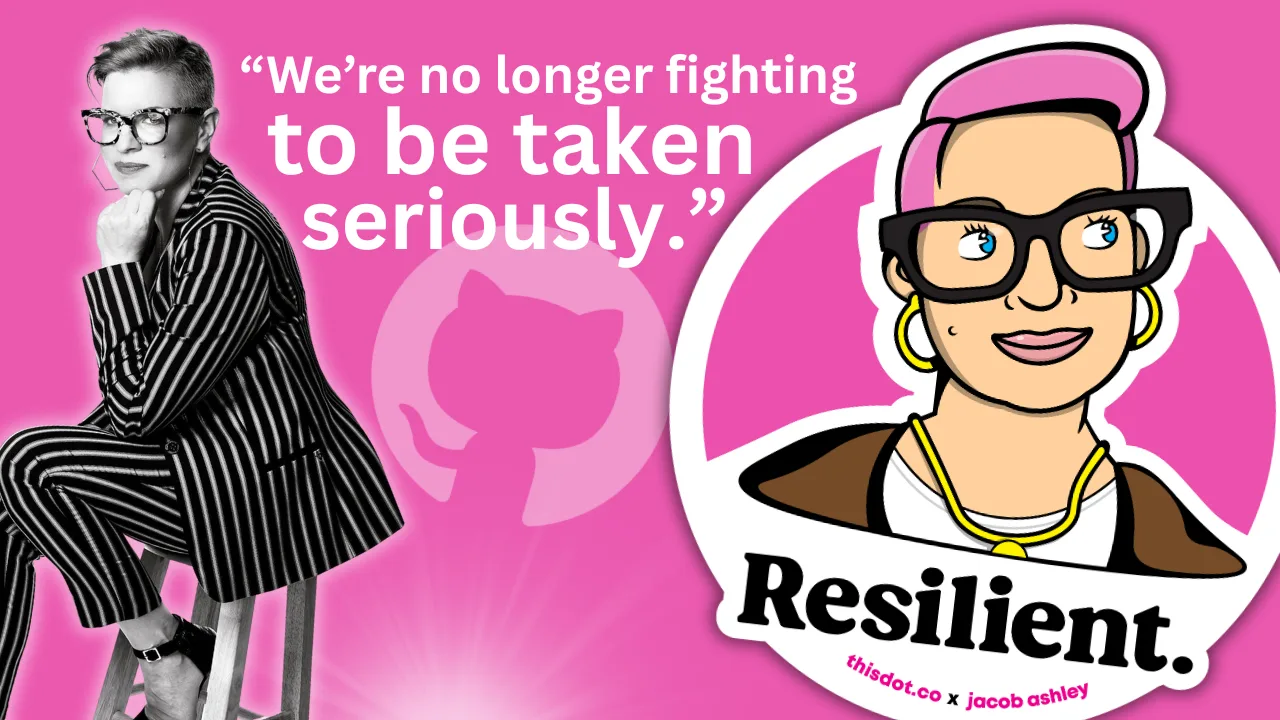
“We were seen as amplifiers, not collaborators,” Ashley Willis, Sr. Director of Developer Relations at GitHub, on How DevRel has Changed, Open Source, and Holding Space as a Leader
Ashley Willis has seen Developer Relations evolve from being on the sidelines of the tech team to having a seat at the strategy table. In her ten years in the space, she’s done more than give great conference talks or build community—she’s helped shape what the DevRel role looks like for software providers. Now as the Senior Director of Developer Relations at GitHub, Ashley is focused on building spaces where developers feel heard, seen, and supported. > “A decade ago, we were seen as amplifiers, not collaborators,” she says. “Now we’re influencing product roadmaps and shaping developer experience end to end.” DevRel Has Changed For Ashley, the biggest shift hasn’t been the work itself—but how it’s understood. > “The work is still outward-facing, but it’s backed by real strategic weight,” she explains. “We’re showing up in research calls and incident reviews, not just keynotes.” That shift matters, but it’s not the finish line. Ashley is still pushing for change when it comes to burnout, representation, and sustainable metrics that go beyond conference ROI. > “We’re no longer fighting to be taken seriously. That’s a win. But there’s more work to do.” Talking Less as a Leader When we asked what the best advice Ashley ever received, she shared an early lesson she received from a mentor: “Your presence should create safety, not pressure.” > “It reframed how I saw my role,” she says. “Not as the one with answers, but the one who holds the space.” Ashley knows what it’s like to be in rooms where it’s hard to speak up. She leads with that memory in mind, and by listening more than talking, normalizing breaks, and creating environments where others can lead too. > “Leadership is emotional labor. It’s not about being in control. It’s about making it safe for others to lead, too.” Scaling More Than Just Tech Having worked inside high-growth companies, Ashley knows firsthand: scaling tech is one thing. Scaling trust is another. > “Tech will break. Roadmaps will shift. But if there’s trust between product and engineering, between company and community—you can adapt.” And she’s learned not to fall for premature optimization. Scale what you have. Don’t over-design for problems you don’t have yet. Free Open Source Isn’t Free There’s one myth Ashley is eager to debunk: that open source is “free.” > “Open source isn’t free labor. It’s labor that’s freely given,” she says. “And it includes more than just code. There’s documentation, moderation, mentoring, emotional care. None of it is effortless.” Open source runs on human energy. And when we treat contributors like an infinite resource, we risk burning them out, and breaking the ecosystem we all rely on. > “We talk a lot about open source as the foundation of innovation. But we rarely talk about sustaining the people who maintain that foundation.” Burnout is Not Admirable Early in her career, Ashley wore burnout like a badge of honor. She doesn’t anymore. > “Burnout doesn’t prove commitment,” she says. “It just dulls your spark.” Now, she treats rest as productive. And she’s learned that clarity is kindness—especially when giving feedback. > “I thought being liked was the same as being kind. It’s not. Kindness is honesty with empathy.” The Most Underrated GitHub Feature? Ashley’s pick: personal instructions in GitHub Copilot. Most users don’t realize they can shape how Copilot writes, like its tone, assumptions, and context awareness. Her own instructions are specific: empathetic, plainspoken, technical without being condescending. For Ashley, that helps reduce cognitive load and makes the tool feel more human. > “Most people skip over this setting. But it’s one of the best ways to make Copilot more useful—and more humane.” Connect with Ashley Willis She has been building better systems for over a decade. Whether it’s shaping Copilot UX, creating safer teams, or speaking truth about the labor behind open source, she’s doing the quiet work that drives sustainable change. Follow Ashley on BlueSky to learn more about her work, her maker projects, and the small things that keep her grounded in a fast-moving industry. Sticker Illustration by Jacob Ashley....
Apr 18, 2025
3 mins
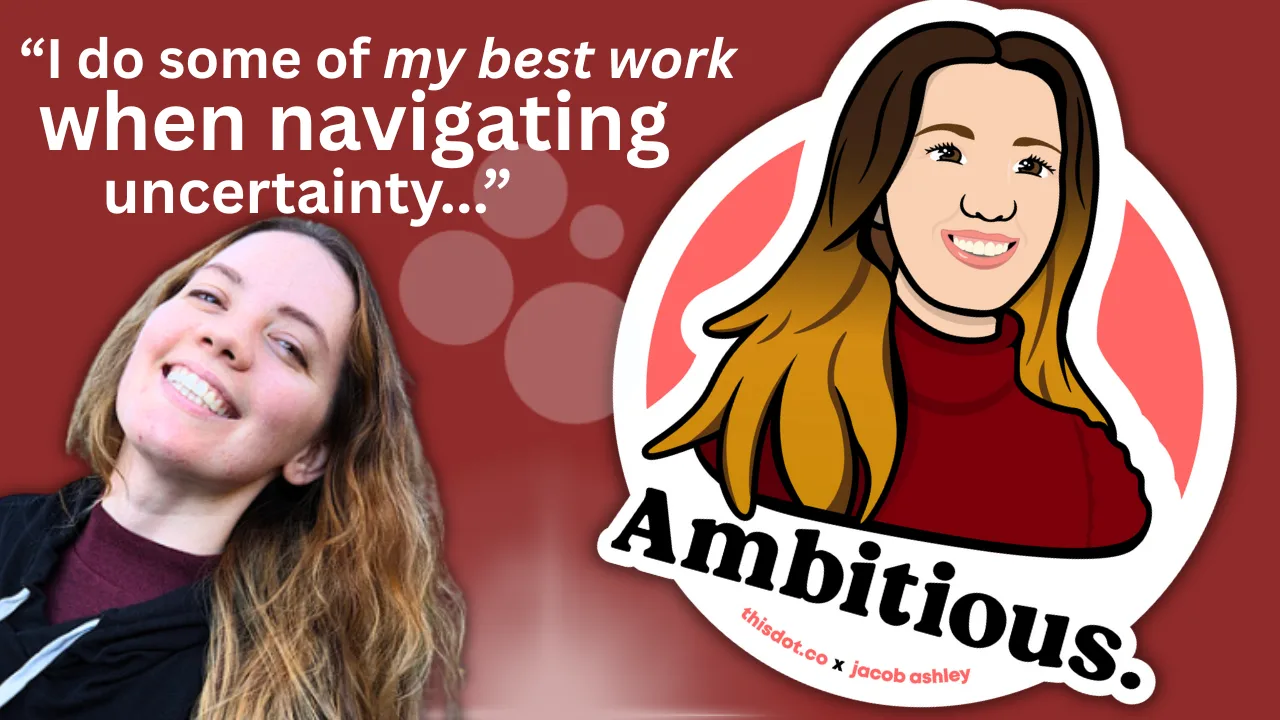
“Recognize leadership behavior early. Sometimes people don’t even realize it in themselves…” Kelly Vaughn on Product Leadership, Creating Pathways for Women in Tech, & Conferences
Some leaders build products. Some lead engineering teams. Kelly Vaughn is doing both. As Director of Engineering at Spot AI—a company building video intelligence software—Kelly recently expanded her role to oversee both Product and Engineering for their VMS offering. That shift means juggling strategy, execution, and team development, all while helping others step confidently into leadership themselves. And yes, she still finds time to speak at conferences and answer DMs from people navigating the same transitions she once did. We spoke with Kelly about spotting leadership potential early, why ambiguity doesn’t have to feel chaotic, and the lesson she learned the hard way about managing up. Stepping into Product Leadership Kelly’s new title might look like a promotion on paper, but the shift is more philosophical than anything. > “Engineering leadership is about execution,” she says. “Product leadership is about defining why we’re building something in the first place.” Now leading Product and Engineering for Spot AI’s VMS product, she’s talking to customers, researching market trends, and making smart bets on where to invest next. It’s a role she’s clearly energized by. > “I’m really looking forward to dedicating time to shaping our product’s future.” Thriving in Ambiguity Some people panic when problems are fuzzy or undefined. Others use it as fuel. > “There are two key traits I see in people who handle ambiguity well,” Kelly says. “They stay calm under stress, and they know how to form a hypothesis from a vague problem statement.” That means asking the right questions, taking action quickly, and being totally okay with pivoting when something doesn’t pan out. It’s no surprise that these same traits overlap with great product thinking—a mindset she’s now leaning into more than ever. > “I do some of my best work when navigating uncertainty,” she adds. Read Kelly’s blog on embracing ambiguity in Product! Creating Leadership Pathways for Women in Tech When asked how leaders can create more leadership pathways for women in software engineering, Kelly stressed that it is not a passive process. > “Senior leaders need to be proactive,” Kelly says. “That starts with identifying and addressing bias across hiring, promotions, and day-to-day interactions.” She emphasizes psychological safety—so women feel confident advocating for themselves and others. But she also knows not everyone feels ready to raise their hand. > “Don’t wait for someone to ask for a title change or a growth opportunity. Recognize leadership behavior early. Sometimes people don’t even realize it in themselves yet.” On Stage, In Real Life Kelly’s no stranger to the tech conference circuit—often giving talks on engineering leadership and team growth. Her biggest source of inspiration? Conversations with people trying to make the leap into leadership. > “I might use the same slide deck at three conferences,” she says, “but the talk itself will be different every time.” Rather than sticking to a script, she likes to share recent examples from her own work, tailoring the delivery to the audience in front of her. It keeps things relevant, grounded, and never too polished. Between setting product strategy, mentoring the next generation of leaders, and hopping from one tech conference to the next, Kelly Vaughn is showing what it means to lead with clarity—even when things are unclear. She’s not here to tell you it’s easy. But she will tell you it’s worth it. Connect with Kelly Vaughn on Bluesky. Sign up for Kelly Vaughn’s Newsletter! Sticker Illustration by Jacob Ashley....
Apr 4, 2025
3 mins

“ChatGPT knows me pretty well… but it drew me as a white man with a man bun.” – Angie Jones on AI Bias, DevRel, and Block’s new open source AI agent “goose”
Angie Jones, VP of Developer Relations at Block, champions developer advocacy, AI ethics, and leadership. She’s leading discussions on AI governance, bias in career tools, and *goose*, an open-source AI assistant for developers....
Mar 13, 2025
4 mins
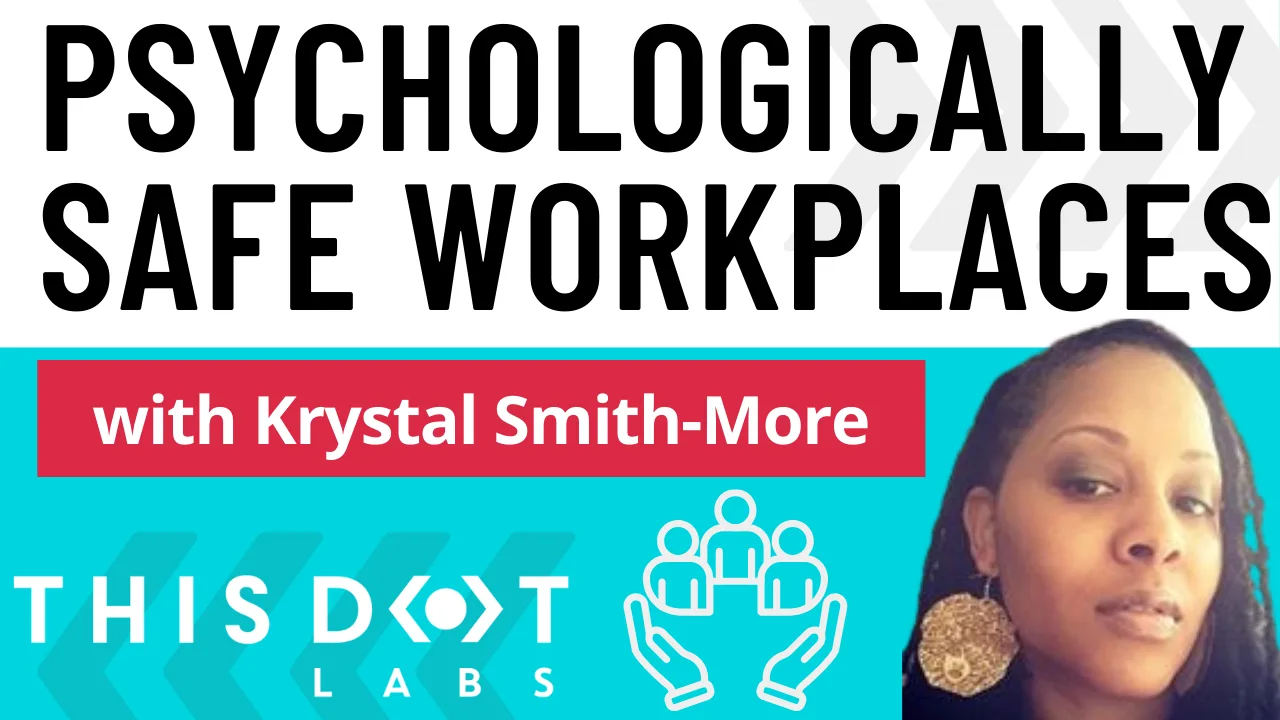
Psychologically Safe Workplaces with Krystal Smith-Moore
Krystal Smith-Moore, Engineering Manager at Spotify, shares her journey from a non-traditional background to management, and how it informs her empathetic leadership approach. Krystal emphasizes the significance of self-awareness, seeking support, and aligning personal values with management roles. By ensuring our values align with the company's mission and culture, we can create a more fulfilling leadership experience. Krystal stresses the need for self-care, setting boundaries to prevent burnout, and recognizing when it's time to recharge. By prioritizing self-care, leaders can maintain their energy and enthusiasm, leading to better decision-making and a more positive work environment. She also discusses the importance of empathy, continuous learning, and creating psychologically safe workplaces where employees feel comfortable expressing their ideas and concerns. By aligning personal values with management roles, prioritizing self-care, and fostering a psychologically safe workplace, leaders can create a positive and impactful experience for themselves and their teams. Download this episode here....
Jun 13, 2024
1 min
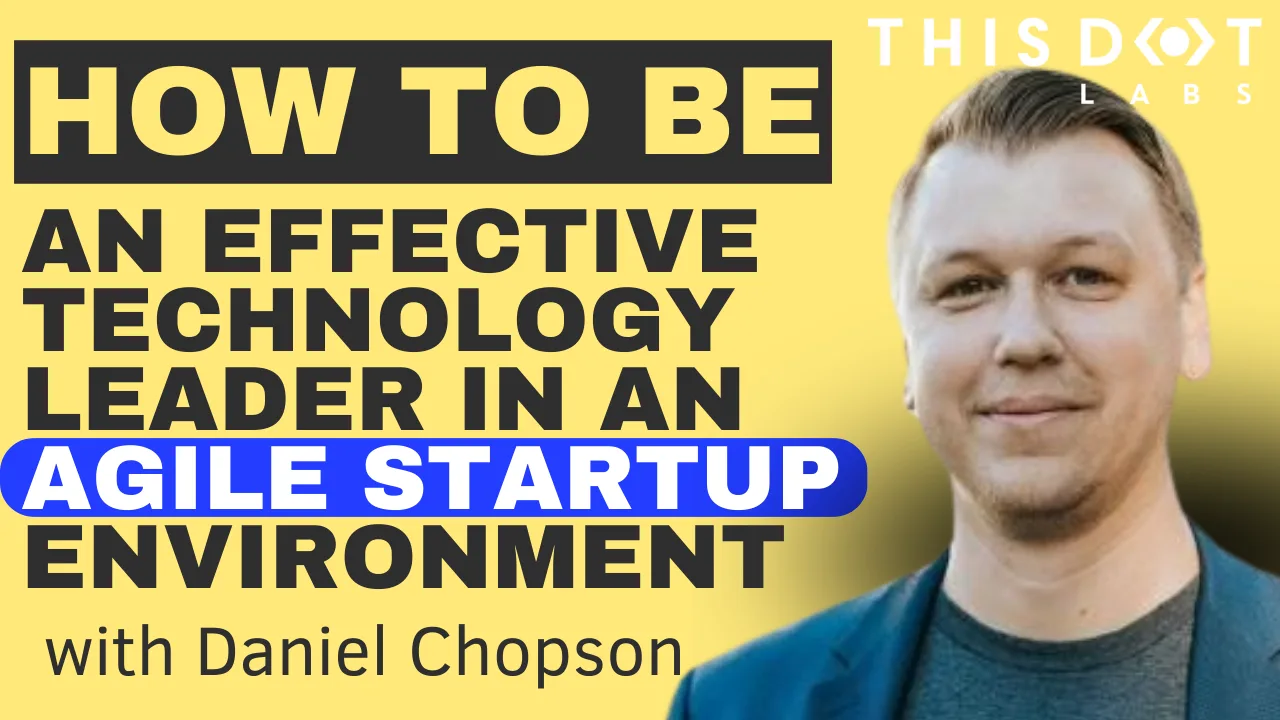
How to be an Effective Technology Leader in an Agile Startup Environment with Daniel Chopson
Daniel Chopson, CTO and co-founder of Cove Tool, discusses key aspects of engineering leadership, team management, and software development in the fast paced startup environment. Cove.Tool, initially a sustainability-focused software company, has evolved to offer AI-driven solutions for architects and engineers. Daniel shared valuable insights on the importance of productive retrospectives, agile planning, and strategic team structuring. Daniel emphasized the significance of conducting productive retrospectives to foster team improvement and effective communication. By celebrating wins and establishing clear action items, teams can identify areas for growth and implement necessary changes. These retrospectives provide a platform for open and honest discussions, enabling teams to learn from their successes and failures. Encouraging a culture of continuous improvement allows engineering leaders to drive innovation and enhance team collaboration. In a startup environment, balancing planning and agility is crucial for success. Cove.Tool prioritizes shorter-term sprint planning to allow for real-time feedback and adaptability. By aligning work towards business objectives while maintaining flexibility in planning, the team can respond quickly to changing market demands. This approach enables Cove.Tool to stay ahead of the curve and deliver high-quality solutions to their clients. The key lies in finding the right balance between long-term strategic planning and the ability to pivot when necessary. Team structuring plays a vital role in engineering leadership. Daniel highlighted the importance of specialized roles like engineering managers and tech leads for effective people development and technical guidance. Engineering managers focus on nurturing the growth and well-being of team members, while tech leads provide technical expertise and mentorship. This division of responsibilities ensures that both the personal and technical aspects of team development are adequately addressed, leading to a more productive and motivated workforce. The conversation underscored the significance of adaptability, feedback-driven decision-making, and strategic team structuring in successful software development endeavors. By embracing change and continuously seeking feedback, engineering leaders can make informed decisions and drive innovation. Strategic team structuring, with specialized roles and clear responsibilities, ensures that the right people are in the right positions to maximize productivity and foster growth. Effective engineering leadership is essential for adapting to changing market demands and building teams equipped to tackle future challenges. Download this episode here....
May 24, 2024
2 mins
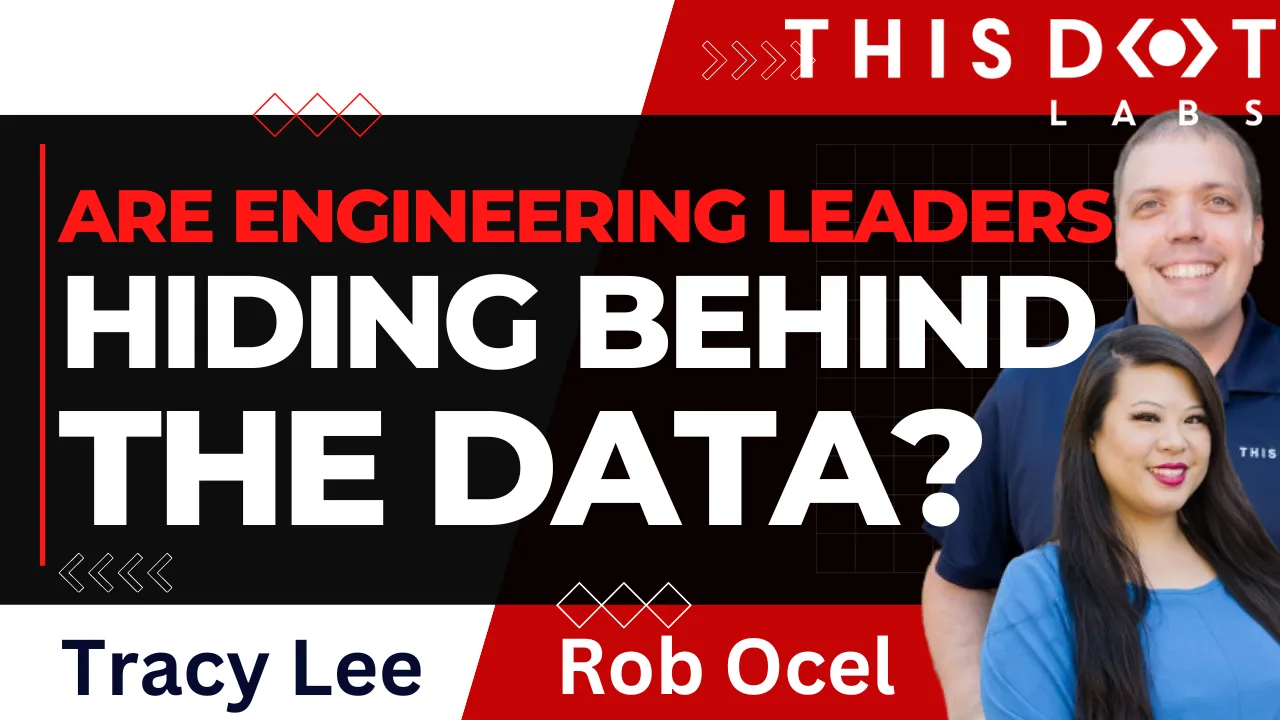
Are Engineering Leaders Hiding Behind the Data?
Many engineering leaders when they start out find themselves just wanting to please everyone around them. Figuring out how to “own” the role is quite difficult for many. Rob Ocel, Engineering Lead and Tracy Lee, CEO at This Dot explore this topic on this episode. They discuss the idea of hiding behind the data. When decisions are made, it’s easy to ask for data, but then make decisions solely based on that data and not form or “own” an opinion around that decision so you can’t get blamed for an opinion you had. Rob encourages leaders to have opinions and be willing to fight for them. Another topic covered was making people unhappy in a deliberate way. Are you able to succeed doing so, and do you have the ability to “own” that? Rob also emphasizes the need for self-awareness and self-introspection, and to have mentors and accountability partners to help guide decision-making. Listen to the full podcast here: https://engineeringleadership.podbean.com/e/are-engineering-leaders-hiding-behind-the-data-with-robocel-tracy-lee/...
Jan 24, 2024
1 min
Cybersecurity Leadership 101 with Dr. Joye Purser
Dr. Joye Purser is the field Chief Information Security Officer (CISO) at Veritas, a software company specializing in data backup systems. Veritas' global leadership in cybersecurity plays a critical role in data backup and restoration in the cybersecurity landscape. Dr. Purser's career ranges from her time at the Cybersecurity and Infrastructure Security Agency (CISA) for the U.S. Department of Homeland Security to roles at the Pentagon and the White House. Dr. Purser talks about common misconceptions regarding working in the government in the field of technology and notes the increasing trend of tech companies recruiting individuals with defense and military backgrounds due to rising threats to the private sector. There is an evolution in cybersecurity, particularly post-pandemic, with an increased sophistication of cyber threats and a rise of ransomware attacks. There is now a heightened focus on critical infrastructure security and a new outlook on the potential life-threatening consequences of cyber disruptions. The qualities of effective cybersecurity leadership are vision, adaptability, and emotional intelligence. Dr. Purser elaborates on the importance of having a clear vision, especially in an emerging role like hers at Veritas. She shares her experience obtaining the Certified Information System Security Professional (CISSP) certification, highlighting the necessity of adaptability in acquiring new skills and staying ahead of the rapidly changing cybersecurity landscape. Dr. Purser stresses the significance of soft influencing skills, adaptability in communication styles based on the audience, and the ability to read the room. She emphasizes the need for emotional intelligence when asking for resources or driving change, recognizing the discomfort associated with these demands. Listen to the podcast here: https://engineeringleadership.podbean.com/e/joye-purser/...
Jan 16, 2024
2 mins
Innovation is NOT Just Creating Something New: Dylani Herath, FinTech Leader
Dylani Herath, a well known FinTech leader who has worked at organizations such as Greenwood, JP Morgan, and FIS sat down with Rob Ocel, Engineering Lead at This Dot Labs and shared some insight on how digital leaders can improve culture and lead...
Jan 10, 2024
3 mins
Engineering Management: Just a Detour? - Charity Majors, CTO at Honeycomb
Rob Ocel interviews Charity Majors, CTO at Honeycomb on engineering leadership. Engineering management was once thought of as an inevitable destination for engineers who sought advancement in their careers, but now engineers have more options than ever. Many engineering managers are becoming engineers again, and the role of manager requires a significant amount of emotional labor. Should anyone want to be an engineering manager? Charity shares her journey of becoming an accidental CTO and founder, despite never aspiring to be a manager. She talks about the importance of engineering managers, and how they help teams outperform those without one, but acknowledges the role is challenging and not always enjoyable. Charity and Rob discuss how good managers can transform a company. They are compared to the nervous system of a company, routing information and ensuring everyone has what they need to succeed. Charity highlights the difficulty engineers face when transitioning from a ticket system to a more autonomous work environment. This shift can be challenging, as engineers may struggle with the newfound freedom and responsibility. It can take years to fully make the transition, so leaders looking to promote engineers to management need to be committed to and patient with the transition. Both Charity and Rob agree that a strong social support system for engineering managers is necessary as the role can be isolating, and having a network of peers who understand the challenges can be invaluable. Charity Majors' experiences and perspectives shed light on the challenges and rewards of the role, and when engineers should and should not pursue this career path....
Jan 4, 2024
2 mins
Let's innovate together!
We're ready to be your trusted technical partners in your digital innovation journey.
Whether it's modernization or custom software solutions, our team of experts can guide you through best practices and how to build scalable, performant software that lasts.